
This topic will show the work that I am doing as a student for this class. It’s from the Dept. of Wortcunning, taught by Prof. Barrette. It’s one of three gardening classes I’m working on right now.
Here’s the class description:
One key to effective garden design is the concept of themes. This class explains how to design a garden based on a central idea. The two examples included are a Moon Garden and a Healing Garden. You need a bit of space to grow one modest-sized garden, preferably outdoors but you can grow a container garden indoors if necessary. Expect this to take 2-3 months. You may choose either theme or design your own. You’ll need suitable gardening tools and a camera (digital, or film with a scanner) to take snapshots.
I'm going to be planting a "tea garden," one that will feature medicinal and culinary herbs for making into teas and infusions.
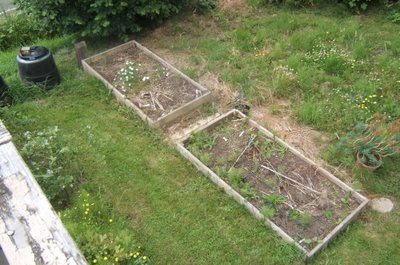
Above is a view (from the second-story deck) of my two raised planting beds. The one in the foreground will hold my veggies-- tomatoes, basil, lettuce, etc. The one in the rear will be the site of the tea garden. As you can see, there's lots to do first!
June 17, 2006. My email to EB, explaining my initial thoughts and plans:
For 601, I propose planting a "tea garden." I have an unused framed, raised bed, about 4' x 12 feet. I will use a combination of seeds and plants to create a garden that will provide me with materials for making infusions, both for delicious and medicinal reasons. This will be especially important as I'm taking many of my bottles of dried goodies to Conclave for student use, so I'll be ready to replenish my stocks. A formal plan is to follow.
In all cases, my funds are somewhat limited. But I have a lot of raw materials at hand-- garden tools, compost, etc.--and am gifted to live in Zone 8, with a growing season that has become almost year-round. I also have an all-organic garden, which helps it thrive. I also have some volunteer starts from rosemary and summer savory plants already growing in my yard.
June 19, 2006. EB has said “yes” to all three and has officially approved me to work on W401, 402, and 601 simultaneously.
Email note from EB:
“All my gardening classes include keeping a Garden Journal for the duration of the class. For our special arrangement, 1) you can keep just one Journal for all your gardens, as long as you keep notes on all three of them, and 2) you should start journaling for each garden when you beginning planning or working on it.”June 24, 2006. Saturday. HOT today—92 degrees and supposed to be pushing 100 in the next two days. I had planned to start putting in my tea garden a couple of days ago but got busy and didn’t get around to it—now I’m really glad I didn’t. The baby seeds and plants would have been cooked.
July 9, 2006. Still haven’t planted my garden, as it has been blazingly hot. The starts are in a sheltered spot in the driveway, out of the Sun, Fortunately, our growing season goes into October, so there’s still plenty of time.
July 10, 2006. Picked up some bags of mushroom compost and topsoil and topped off the raised bed that the tea garden will be planted in. When you use raised beds, they inevitably settle over time, and you also lose soil if/when you pull up and discard plants. Last year my tomatoes were in this bed, and at season’s end I pulled up the plants whole, as tomatoes can harbor diseases that one doesn’t want to propagate.
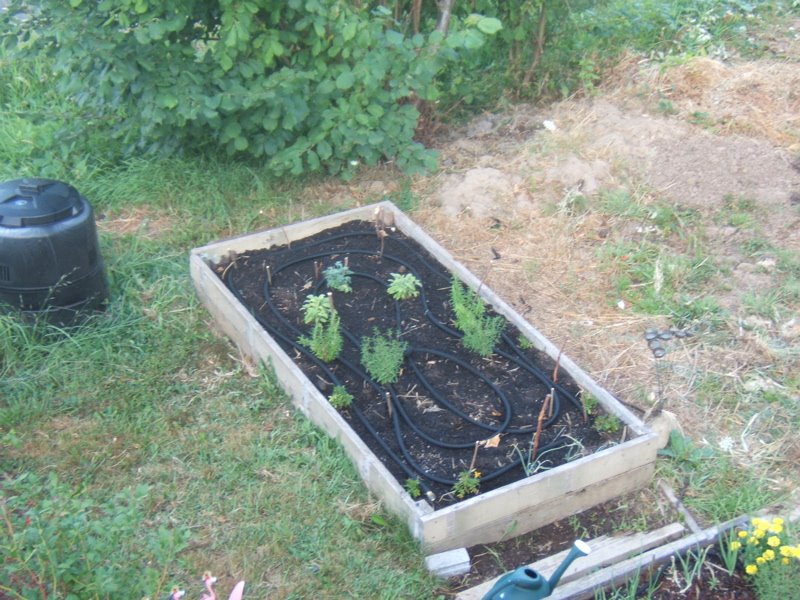
I laid a soaker hose atop the soil for later irrigation. I’ve always used soaker hoses on my veggies and herbs, with great results—and it saves water, too. Once the plants have reached a certain size, I’ll lay mulch around the plants and over the hose; it’s a great way to conserve water.
 July 12-13, 2006
. Today I planted my tea garden! I planted in the morning, a time of day synonymous with growing energies and new starts. We’re on the waning Moon, but I am already late getting this garden into the ground—I’m going to count on the soil and Sun to make up for a less-than-favorable lunar influence.
The planting box is on a north-south axis, which means I had to be careful about plant heights, so that as the sun moves from east to west along its ecliptic path, it doesn’t cause taller plants to shade shorter ones behind them. I’ve actually sketched out an arrangement that should work.
Before planting, I weeded the raised bed thoroughly and used a small shrub rake to tumble up and loosen the soil. I planted both plants and seeds: rosemary, variegated sage, summer savory, rue, anise, fennel, hyssop, anise hyssop, thyme, and calendula. At left is the result.
Note: I have lemon balm, basil, parsley, catnip, mint, oregano, echinacea, and several other herbs growing in other locations in my yard, so I intentionally didn't include these in my tea garden. I have several other varieties of sage and thyme as well.
July 19, 2006. So far, so good. The starts and transplants are all doing well—I haven’t lost even one, as best I can tell. And the first seeds—some of the thyme—have germinated.
Tomorrow is Conclave, which means I have to leave my babies behind during a 100+ degree week! Augh! Luckily Bill will be home all but one day and evening, and he’ll water them in the morning before work and then again when he gets home.
July 20-23, 2006. CONCLAVE! It was even hot in the forest, and in Portland, one of the days reached 105! All I could do was hope Bill was taking care of all of the plants—not just my tea garden. He’s really good with plants, so I felt pretty good about it. But hey, it really didn’t matter, because no way was I missing Conclave!
Bill came out to Conclave on the evening of the 22nd; he’d watered the heck out of everything before he left: he added some mulch to the tea garden and put a sheet/awning over it to shield the babies from the hot sun during the 24 hours they wouldn’t be watered.
July 24, 2006. Everything survived our absence--the starts and transplants are all fine, and all of my seeds except the anise hyssop (which are slow germinators) have sprouted. Below is a photo of the garden and a closer image showing a row of nicely sprouted anise.

 July 27, 2006
. Everything is thriving—the starts have actually begun to add size. All of the seeds have sprouted except for the anise hyssop, which seems to have gone MIA. Wonder if I got a tired bunch of seeds?
 August 2, 2006
. Today is Lughnasadh! It’s a waxing moon--a fine time to plant or honor things that grow mostly above ground. I went out very early (not at sunrise, I confess—but still early) and did a short ritual to honor the fecundity of the Earth and her elements. The ritual was spontaneous and not written down, but here is a quick summary of what I did:
- I washed my hands and face, slipped on a cloak and a green (wortcunning) shawl, and gathered my materials in a wicker gardening basket.
- The irony of Imbolc being the "First Harvest" wasn't lost on me-- I had no harvest yet, thanks to planting late. But I was still thrilled with the garden's progress, and anxious to honor that.
- My materials included: an altarcloth; a piece of bread; an abalone shell; matches; a sweetgrass bundle (from sweetgrass grown in my yard); salt; small containers of cream, water, and marionberry cordial (the latter made in the fall of 2005); and my applewood wand.
- I processed silently out to the garden space. I arranged my materials on an altarcloth on the grass next to the planting box.
- I spent several minutes in silence, listening and meditating, trying to connect with the energy of the place. It was a sunny morning, and already warm. There was a light breeze.
- I raised my hands and wand and called the quarters/elements.
- I then paid homage to the elements by "annointing" the garden; I lit a sweetgrass smudge and wafted its smoke over the garden's eastern corner, and then over the rest of the garden, and then over myself. I snuffed out the smudge and sprinkled a few of the cooling ashes over the garden's southern edge. I sprinkled water on the western edge, and finished by scattering salt in the northern portion.
- I then thanks the garden for its enthusiasm and fecundity. I drizzled a small portion of cream over the soil, and then toasted with my own glass of cordial (drinking it-- not pouring it on the ground!).
- I then pulled back the quarters, and offered a murmured blessing over the land before gathering my goodies and going back to the house.
- Shortly after, I returned and gave the garden the blessing of a thorough watering!
I have officially given up on the anise hyssop—there’s absolutely no sign of it germinating. Either I got some old seeds, or the heat was too much for them. I suspect the latter—it’s my own fault for starting so late. Anyway, I still have hyssop-- even though it's quite different in flavor and use than anise hyssop-- and I also have anise. Anise hyssop is my all-time favorite tasty tea ingredient, so I'm mourning its absence. Wll try again next year.
August 8, 2006. Things are coming along. Even though I got a late start planting, everything is growing robustly, probably thanks to our long, very warm, days and the fact that the tea garden is in a raised bed and sited where it gets 12-14 or more hours of sun each day. Yay! Our climate stays warm into early October, so I think there's still plenty of time for growing. The raised bed is a real plus; it provides good drainage and also keeps the soil warm, speeding everything along. Ditto for the fact that the bed is brimming with organic compost.
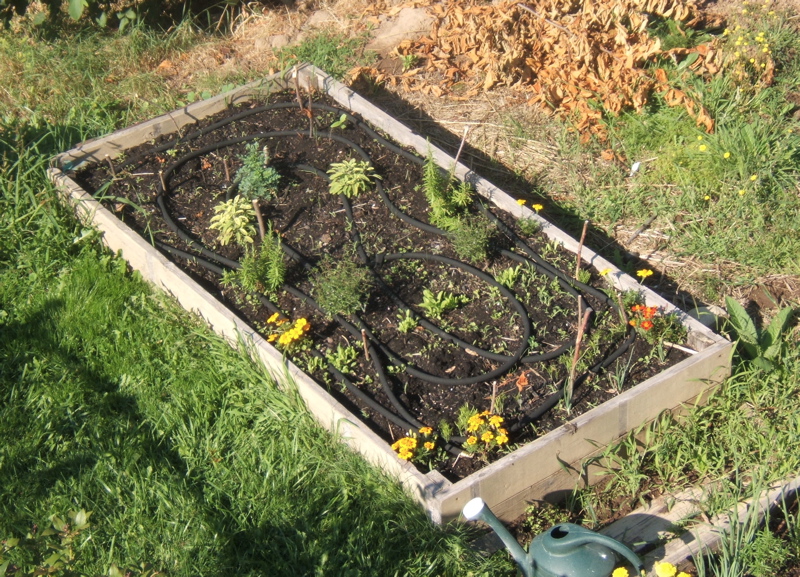
August 28, 2006. Here's a photo of the garden.... The fennel and anise are shooting up and the summer savory is just beginning to flower. Tomorrow morning I'll cut the summer savory back and save it for drying-- it is amazing when added to vegetable and egg dishes. (I can’t imagine cooking without it!) The bees also love it, if you allow it to go into full flower, which I don’t usually do, as the herb itself is much better if you harvest it before it flowers.

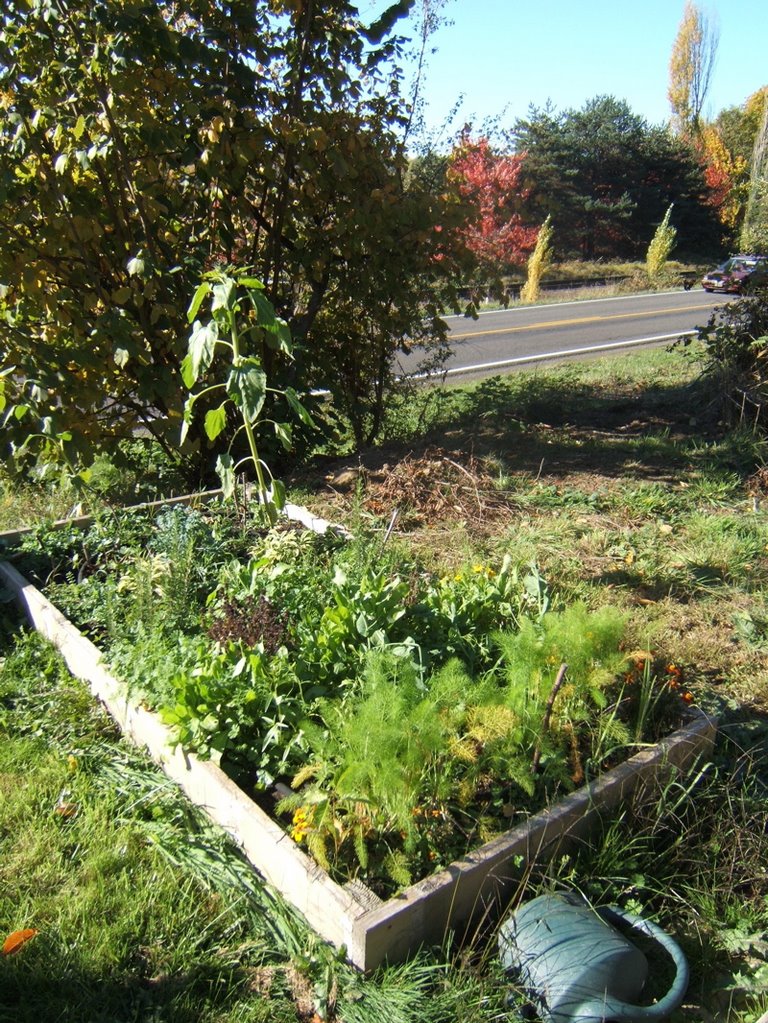
Notice the volunteer sunflower-- a gift from the birds!
(I thought I had another picture of the garden taken around mid- to late September, but I can't find it. I must have accidentally deleted it. Imagine the same picture as above, but with everything even bigger. The little raised bed looked as if it was overflowing!)
One thing I've noticed about using raised beds is that you can cram a lot more into them than in a similar space in the ground. I suspect it's because the warmth and good drainage create an optimum setting that can support more than the usual amount of plant mass.
Sept. 18, 2006. I was tempted to start harvesting, but the days were still warm and the nights hadn't really begun to cool yet. I decided to hold out for another week or two. The fennel hasn't produced mature seed heads yet, and it would be nice it I could get some seeds before the garden begins to fade.
Sept. 30, 2006. Bill is off on his annual hunting trip, and this was a perfect time to harvest my garden. I cut herbs early in the morning. I soaked them in a sink full of mild salt water (a good way to cleanse them and to kill bugs or parasites), then rinsed them and allowed them to dry on newspaper set out all over the living and dining room (again, it was very convenient that Bill was gone!).
I left the fennel in place for now-- the seed heads aren't ripe yet, and I'm hoping there's still some time for them to finish up. The nights are cooling a little, but still staying around 48-50, and the raised beds will stay warm for lots longer than the earthly soil.
I also went around the yard and harvested mint, lemon balm, oregano, catnip, and others.
Oct. 1, 2006. After checking the herbs to make sure the were dry, I bound them into loose bundles and hung them in Bill's office room to dry. It already smells great in there.
I've had a great result, I think, considering it's a relatively small garden and I started late. I'm honestly a bit suprised at how productive it was-- I can only imagine the results I'd have gotten if I'd planted a month or two sooner.
Oct. 16, 2006. I harvested the fennel, both the seedheads (only a few matured)-- which will dry on flat trays-- and the bulbs (small, but should still be tasty), which I will use in the kitchen. I have a great fresh green bean and fennel recipe.
Now for a little bit about my component plants:
 AnisePimpinella anisum;
 a member of the parsley (
apiaceae or
umbelliferae) family.
Folk names: Anneys, Aniseseed, Yanisin, Sweet Cumin (1).
Culinary uses: Has a light licorice taste; very tasty in tea, used in some breads, pastries, etc.
Medicinal uses: digestive upsets, toothache (when applied locally to the affected tooth). The essential oil can treat lice and scabies infestations. Magickal uses: Protection, purification, youthfulness (1).
Garden notes: Germinates quickly, then grows robustly.
 CalendulaCalendula officinalis
;
Aster family: asteraceae or, alternatively,
compositae.
Folk names: Bride of the sun, Drunkard, Goldes, Holigolde, Husbandman's Dial, Marybud, Marygold, Mary Gowles, Ruddes, Ruddles, Spousa Solis (Summer's Bride) (1). Also known as "pot marigold."
Culinary uses: the petals are edible and attractive additions to salads.
Medicinal uses: a petal infusion or tincture can be taken orally for GI upset, ulcer, and sore throat. The infusion can also be used topically as a treatment for skin infections, blisters, etc. A mixture of dried or frozen petals, carrier oil, and either beeswax or melted petroleum jelly makes a soothing ointment or cream, useful for any local skin problems, rashes, etc. (2). The leaves can be macerated for a poultice for gout or arthritis (2).
Magickal uses: Protection, prophetic dreams, legal matters, psychic powers (1).
Garden notes: very easy to grow with little. Produces more flowers if pruned. Annual plant, but self-seeds and regrows year after year.
 Fennel
Foeniculum vulgare; a member of the parsley (apiaceae or umbelliferae) family.
Folk names: Samar, Sweet Fennel, Sheeh (1).
Culinary uses: Yet another licorice-flavored plant. Bulb, foliage, and seeds used in cooking.
Medicinal uses: Fennel is seen as a warming herb, and is often used to treat chills (and associated fever), as well as asthma and lung problems. Infusions, tinctures, and decoctions are used to treat digestive problems (2). the essential oil makes a good chest rub for congestion (2). A root decoction is affective for kidney stones (2).
Magickal uses: Protection, healing, purification. In Dionysian ceremonies, the staff-like thyrsus was a twined combination of pine cone, staff, and fennel stalks (1).
Cautions: Fennel is a known uterine stimulant and should be avoided during pregancy and the post-partum period (2).
Garden notes: Easy to grow; likes well-drained soil and a fair amount of water.
 Hyssop
Hyssopus officinalis; member of the mint (Laminaceae) family. Folk names: Hyssop Herb, Isopo, Ysopo, Yssop (1).
Culinary uses: imparts a strong minty flavor with bitter undertones; useful in teas.
Medicinal uses: an infusion of aerial parts is superb for treating cough, colds, and upper respiratory infections (URIs); hyssop can likewise be added to any other URI-deisgnated infusion. Thought to have antiinflammatory properties. The infusion is also effective in treating bruises and simple wounds. The essential oil may be used as a nerve tonic. A cogh syrup made from an infusion or decoction is very effective, especially if mixed with licorice root, anise, and/or mullein (2).
Magickal uses: Protection and purification; according to Cunningham, hyssop is the most widely used purifying herb (1).
Garden notes: Easy to grow; responds to pruning by doubling growth. Beloved by honeybees!
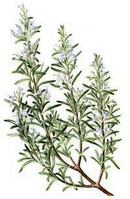 Rosemary
Rosmarinus officinalis; mint (Laminaceae) family.
Folk names: Compass Weed, Dew of the Sea, Elf Leaf, Guardrobe, Incensier, Libanotis (Greek), Polar Plant, Sea Dew (1)
Culinary uses: Lovely flavoring for meats and roasted vegetables. Woody stems can be used a skewers for grilling.
Medicinal uses: The infusion is excellent for colds, flu, and other upper respiratory infections. A concentrated tincture is a powerful tonic/stimulant, and useful for depression (2). The essential oil may be added to a bath to ease joint and muscle pain, or diluted in a carrier oil for a soothing massage (esp. good for arthritic conditions (2)).
Magickal uses: Protection, love, lust, mental powers, exeorcism, purification, healing, sleep, youth (1).
Garden notes: Rosemary will grow well regardless of what you do to it. It's about the most tolerant plant I know--surviving heat, cold, varied water, bad soil, etc.--and grows robustly. If you prune a branch, the plant will set a "fork" and grow bushier. Rosemary is an evergreen perennial shrub.
 Rue
Rue
Ruta graveolens. Family Rutaceae ("citrus fruit" family (3)).
Folk names: Bashoush (Coptic), Garden Rue, German Rue, Herb of Grace, Herbygrass, Hreow, Mother of the Herbs, Rewe, Ruta (1). Culinary uses: The leaves are bitter, but rich in iron and trace minerals; they are a powerful addition to salads when used sparingly. Traditional flavoring for grappa and other alcholic beverages (3).
Medicinal uses: Stimulant and antispasmodic actions. Used to treat a wide variety of conditions, including hypertension, colic, digestive problems, skin rashes, and (arcane use) epilepsy (3). A leaf infusion makes a soothing eye wash (supposedly used by Michelangelo and da Vinci (3)). The dried aerial parts are useful in insecticidal mxtures.
Magickal uses: Healing, health, mental powers, exorcism, love (1).
Garden notes: Slow-growing, but durable. Rue is an evergreen.
 Summer savory.
Family Labiateae (mint family)
Folk names: Herbe de St. Julien, Garden Savory (1), Herb of Grace (3). Culinary uses: With its peppery flavor, summer savory is a delicious addition to eggs, fish, and vegetables.
Medicinal uses: Aids digestion and soothes dyspepsia. A leaf infusion helps treat skin infections and abrasions. A leaf poultice releves bee stings (3).
Magickal uses: Mental powers (1).
Garden notes: If grown from seed, germinates slowly. Once growing, it's a very sturdy plant that thrives in hot sun and with little water. Self-seeds and creates new plants with ease (these plants are then very easily transplanted.) Best flavor comes when harvested before flowerins begins. A favorite of honeybees.
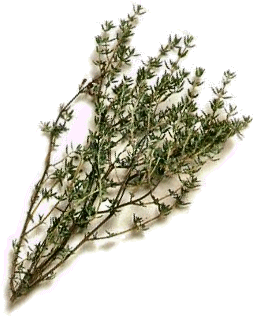
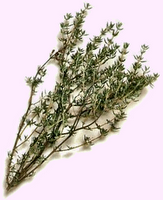 Thyme
Thyme
Thymus vulgaris. Family Labiatae (mint).
Folk names: Common Thyme, Garden Thyme (1).
Culinary uses: Used in flavoring soups and stews; also tasty in egg and vegetable dishes. A traditional flavoring for Benedictine liquers (3).
Medicinal uses: An infusion of aerial parts settles the stomach and bowels and treats sore throats, colds, and respiratory problems. A syrup made from the infusion is effective for cough and bronchitis. The essential oil is antiseptic and a nerve stimulant.
Magickal uses: health, healing, sleep, psychic powers, love, purification, courage (1).
Cautions: Has uterine stimulating properties; avoid use during pregnancy. Can irritate skin and mucous membranes; always dilute well when usign topically.
Garden notes: Easy to grow; needs little water and lots of sun. responds beautifully to trimming. Can be harvest before or during flowering.
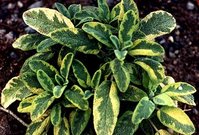 Golden Variegated Sage
Salvia officinalis, var. Icterina. Family Labiatae (3).
Folk names: Garden Sage, Red Sage, Sawge (1).
Culinary uses: roasted meats, especially pork; stuffings; poultry, Medicinal uses: A leaf infusion is a good nerve tonic, and also is a powerful remedy for coughs and bronchial constriction; as a gargloe, the infusion soothes sore throats and inflamed tonsils. May aid with menopausal symptoms through presence of hormonal precursors (3). The root is used in Chinese medicine; I have no experience with this.
Magickal uses: Immortality, longevity, wisdom, protection, wishes (1).
Cautions: Because of hormonal actions, avoid during pregnancy or lactation.
Garden notes: Very easy to grow; loves hot sun and doesn't need much water. Responds well to pruning. A perennial plant, sage survives well through cold winters, although it tends to get woody and a little homely with time, so if it's also being grown as an ornamental, it may need periodic replacing.
Herbal Information Sources:
1. Cunningham, Scott. Cunningham's Encyclopedia of Magical Herbs. St. Paul, MN: Llewellyn, 2005.
2. Ody, Penelope. The Complete Medicinal Herbal. New York: DK Publishing, 1993.
3. Bremness, Lesley. Herbs. The Visual Guide to More Than 700 Herb Species from Around the World. London: DK Books, 1994.
-----
Recipes
A favorite culinary tea recipe:
- Boil 1 cup spring water. Pre-warm a mug with hot water.
- Empty water from mug. Fill an infuser with 1 tsp each of dried spearmint, 1 tsp. anise leaves, and 1 tsp chamomile. Pour boiling water over and steep for 5 minutes. Serve with honey, if desired.
A favorite medicinal tea recipe: good for cold, sore throat, etc.


 Imbolc is a cross-quarter Sabbat that occurs between the Winter Solstice and the Spring Equinox. It is traditionally celebrated on Feb. 2, but falls astrologically several days later.
 This topic will show the work that I am doing as a student for this class. It’s from the Dept. of Wortcunning, taught by Prof. Barrette. It’s one of three gardening classes I’m working on right now.
 Above is a view (from the second-story deck) of my two raised planting beds. The one in the foreground will hold my veggies-- tomatoes, basil, lettuce, etc. The one in the rear will be the site of the tea garden. As you can see, there's lots to do first!
 July 12-13, 2006. Today I planted my tea garden! I planted in the morning, a time of day synonymous with growing energies and new starts. We’re on the waning Moon, but I am already late getting this garden into the ground—I’m going to count on the soil and Sun to make up for a less-than-favorable lunar influence.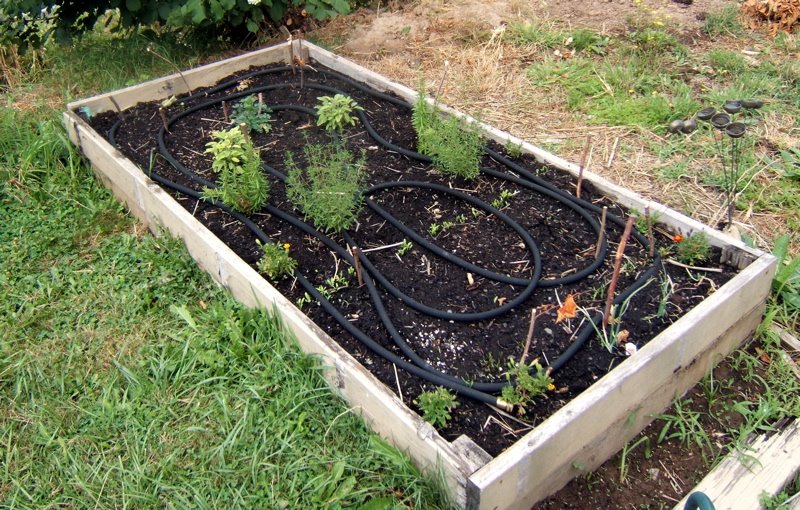

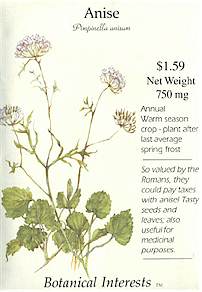 Anise
Anise Calendula
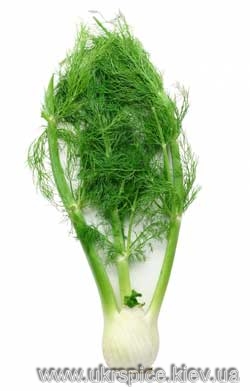 Fennel
 Hyssop
 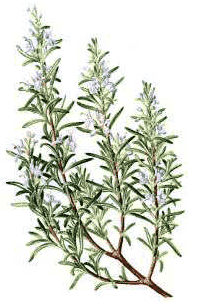 Rosemary
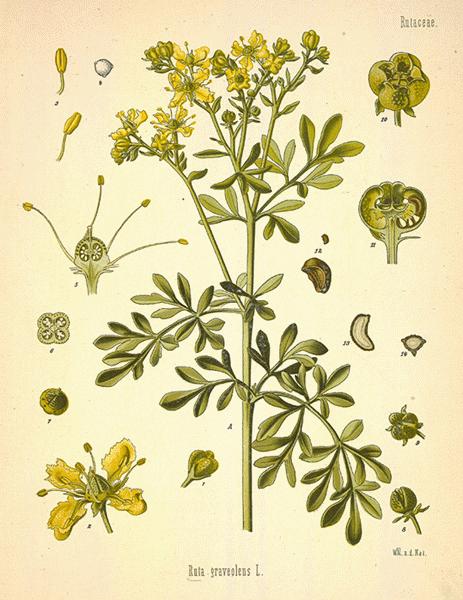 Rue
Rue Summer savory.
 Thyme
Thyme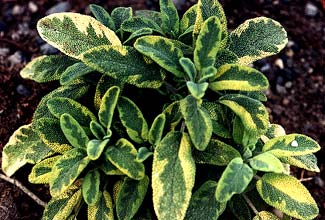 Golden Variegated Sage